
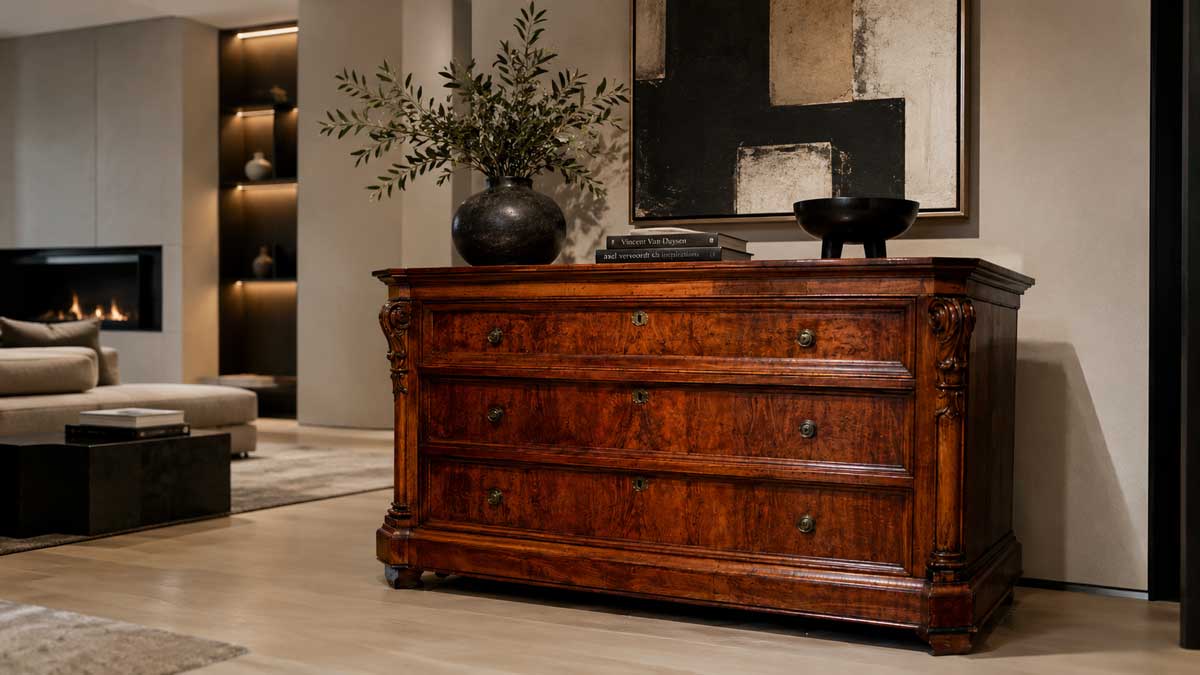
A guide to buying restored antique furniture in Madrid: how to recognise a good restoration, what price range to expect, what to check before you pay, and where to find the dealers who work with real criteria in El Rastro
Buying an antique piece of furniture is nothing like buying a new one. There is no catalogue, no two units are alike, and no spec sheet will settle your doubts. What there is, is one specific piece, with its own history, its own marks and its own state of conservation. That is why anyone looking for antique furniture in Madrid is not choosing between models: they are choosing between pieces that cannot be repeated. And this is where one word changes everything: restored. A well-restored antique is an object that has recovered its function without losing its character. A badly restored one is an antique that has had erased from it precisely what made it valuable.
Restoring is not making a piece look new. It is allowing it to remain what it was, while being usable again.
What a restored antique actually is
Three categories coexist in the market and are routinely blurred in sales descriptions. Understanding the difference is the first filter against overpaying. The distinction is not academic: it directly affects price, durability and how the piece holds its value over time.
Antique, vintage or reproduction: not the same thing
How to recognise a good restoration
The criteria professionals follow today come directly from conservation theory as applied to heritage. Institutions such as the Spanish Cultural Heritage Institute and the American Institute for Conservation uphold two principles that apply just as well to domestic furniture: intervene as little as necessary, and do so reversibly. In practical terms: a good restorer consolidates, repairs and protects, but does not reinvent. Decorative arts museums — from the Victoria and Albert Museum to the National Museum of Decorative Arts — display centuries-old pieces that visibly retain their wear. That is not neglect: it is judgement.
Patina is not dirt. It is the proof that a piece has been lived with.
What to check before buying
Buying antique is also buying well
Beyond aesthetics, furniture with a history answers to a logic of consumption that gains weight every year. The Ellen MacArthur Foundation, a global reference in circular economy, ranks extending a product’s useful life among the most effective strategies for reducing environmental impact. The European Forest Institute, in turn, highlights the role of timber as a durable material when responsibly sourced. Buying an 1890s chest of drawers instead of a new one avoids raw material extraction, manufacturing, transport and packaging. And unlike almost any industrial piece, that chest will still hold value thirty years from now.
An antique has already proved it lasts. Everything else still has to.
Where to buy antique furniture in Madrid
Talking about antiques in Madrid leads inevitably to El Rastro. But the street Rastro and the professional Rastro are not the same thing. The open-air stalls work on chance and on the lucky find; the permanent spaces work on selection, expertise and direct dealing with someone who knows the piece. Within that second circuit, Nuevas Galerías del Rastro, at Ribera de Curtidores 12, brings together several furniture specialists under one roof. The practical advantage is obvious: you compare pieces, periods and prices in a single visit, without crossing half the city and without depending on the weather.
Furniture specialists at Nuevas Galerías
What a restored antique costs
There is no fixed rate, and anyone offering one is oversimplifying. The price of an antique depends on period, timber, cabinetmaker, rarity of the type, condition and the extent of the restoration. Two chests of drawers from the same century can be a factor of ten apart. What can be pinned down are the variables that push the price up or down, and knowing them lets you negotiate from an informed position.
What moves the price
Frequently asked questions about antique furniture in Madrid
Is a restored piece worth less than an untouched one?
It depends on the type of intervention. A respectful restoration — consolidating, repairing and protecting — maintains or even improves the value, because it returns the piece to use. An aggressive intervention that removes the patina or replaces original elements does reduce the value appreciably.
How do I know whether a piece is genuinely antique?
The reliable clues are where nobody covers their tracks: the back, the underside and the inside of the drawers. Irregular saw marks, unevenly darkened timber, hand-cut joinery and hardware with consistent wear all point to real age. Excessive uniformity usually suggests the opposite.
Do antiques work in a modern home?
They work particularly well. A single piece with a history in a contemporary space brings the contrast and depth that mass-produced furniture cannot achieve. The key is restraint: one strong piece works better than a whole room in period style.
Where can I buy antique furniture in Madrid with confidence?
In permanent spaces run by professional dealers, where there is direct contact, real knowledge of the piece and continuity after the sale. Nuevas Galerías del Rastro, at Ribera de Curtidores 12, brings several of these together in one building.
Can I visit any day?
The area around El Rastro is at its liveliest on weekends, but the galleries allow for a far calmer visit midweek, which is when you can talk properly and unhurriedly with each dealer.
Looking for an antique that will genuinely change your home?
If you have read this far, you are probably not looking for one more piece of furniture. You are looking for something with a history, with character, and with the ability to give personality to an entire space. At Nuevas Galerías del Rastro several specialists in antique and restored furniture work side by side, with direct contact and advice from people who know each piece.
📍 Ribera de Curtidores 12, Madrid · El Rastro
You may also like
Specialists in antique furniture, restoration and decoration within Nuevas Galerías del Rastro.



0 Comments